See three equal positions
Before playing, understand that each beat contains three equally spaced points.
A triplet divides one beat into three equal rhythmic positions. In PULSE, you can see those three positions clearly, speak the full group as TA KI TA, and then transfer the pattern to your instrument.

Straight eighth notes divide a beat into two equal parts. Sixteenth notes divide it into four. A triplet divides the same beat into three equal parts.
The tempo can stay exactly the same, but the internal spacing changes. This is why triplets need to be felt as their own rhythmic grid rather than squeezed into a straight subdivision.
PULSE lets you see the triplet grid while the Konnakol phrase TA KI TA gives the three-part subdivision a voice.
▶ Open PULSEFor triplets, the learning sequence is especially simple:
Before playing, understand that each beat contains three equally spaced points.
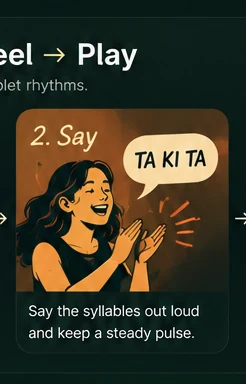
Say the three syllables evenly. Do not let the first syllable become longer than the others.
Tap the beat with your foot or hand while the voice carries the three-part subdivision.
Once the triplet is stable in the voice, play the same pattern on guitar, bass, drums, piano or another instrument.
Keep the beat steady. Say the full triplet phrase first, then play the sounding attacks.
Keep all three positions equal. This is the foundation for every other triplet pattern.
Keep feeling the missing middle position even though it is silent.
In the current PULSE reading system, two sounding attacks in the beat are spoken as TA KA.
Notice how the spoken phrase changes with the number of sounding attacks while the triplet grid remains underneath.
A common mistake is to treat the triplet as a decorative flourish instead of a precise subdivision. The three positions then become uneven — often the middle one is compressed.
Speaking TA KI TA evenly helps keep all three parts the same size. The visual PULSE grid reinforces the same idea by showing the positions directly.
Triplet patterns become difficult when one or two positions are rests. The silence can make the internal three-part grid disappear.
Keep the full subdivision running in the voice or internally, even when only one attack sounds. This makes rests and syncopated triplet patterns much more stable.
This is one of the strongest uses of PULSE. You do not have to search through a long list of generic triplet exercises.
Create the exact bar you are working on, choose the triplet subdivision, add or remove attacks, repeat the difficult measure and see the entire rhythmic shape immediately.
Konnakol gives triplets a natural spoken form because the subdivision can be voiced as a three-syllable phrase. In the current PULSE syllable map, a three-attack group is TA KI TA.
This makes the rhythm easier to remember as a phrase rather than as three abstract points on a page.
Keep the main pulse steady and speak every triplet group before you play it.

Practice sequence:
The difference is not the tempo. It is the internal division of the beat. Straight eighths create two equal positions; triplets create three.
Practicing both helps you switch between rhythmic feels without losing the large pulse.
Understand straight, sixteenth-note and triplet subdivisions.
Rhythm Subdivisions →Feel how a four-part subdivision differs from the triplet grid.
16th-Note Exercises →Use the same internal pulse when attacks fall on weaker positions.
Syncopation Exercises →Use a clear triplet grid to improve consistent note placement.
Timing Exercises →A triplet divides one beat into three equal rhythmic positions.
In the current PULSE Konnakol map, three sounding attacks are read as TA KI TA.
Usually one of the three positions is being shortened or stretched. Slow down and speak TA KI TA evenly over a steady pulse.
Yes. The silent positions are still part of the subdivision and should remain present internally.
Yes. You can build your own triplet patterns, repeat difficult bars and practice them at your own tempo.

Build the triplet pattern, speak it clearly and repeat it until the three-part subdivision feels natural.
▶ Practice Triplets in PULSE